
item2-8 (优惠券秒杀3 - 分布式锁-redission)
分布式锁-redission
简单介绍
之前分布式锁问题
基于setnx实现的分布式锁存在下面的问题:
重入问题(不可重入)
重入问题是指获得锁的线程可以再次进入到相同的锁的代码块中
可重入锁的意义在于防止死锁,比如HashTable这样的代码中,他的方法都是使用synchronized修饰的,假如他在一个方法内,调用另一个方法,那么此时如果是不可重入的,不就死锁了吗?
意思假如方法A先获取锁,然后执行中要用到方法B,然后在方法B中也需要获取相同的锁,但此时锁在方法A里,如果不可重入,就导致方法B一直等,死锁了就
所以可重入锁他的主要意义是防止死锁,我们的synchronized和Lock锁都是可重入的。
不可重试
是指目前的分布式只能尝试一次(非阻塞式),失败了直接返回 false
合理的情况是:当线程在获得锁失败后,可以再等一等再重试,再次尝试获得锁,可以重试
超时释放
我们在加锁时增加了过期时间,这样的我们可以防止死锁,但是如果卡顿的时间超长,虽然我们采用了lua表达式防止删锁的时候,误删别人的锁,但是毕竟没有锁住,有安全隐患
主从一致性
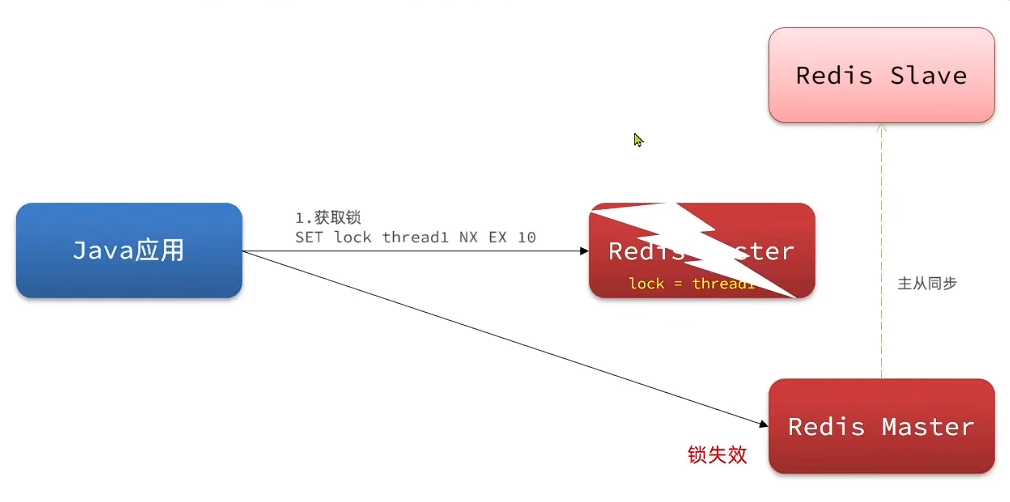
如果Redis提供了主从集群,当我们向集群写数据时,主机需要异步的将数据同步给从机,而万一在同步过去之前,主机宕机了,此时从节点没有锁的数据,导致其他线程可以获取锁,就会出现死锁问题
Redission
Redisson是一个在Redis的基础上实现的Java驻内存数据网格(In-Memory Data Grid)
GitHub:https://github.com/redisson/redisson
它不仅提供了一系列的分布式的Java常用对象,还提供了许多分布式服务,其中就包含了各种分布式锁的实现。
Redission提供了分布式锁的多种多样的功能
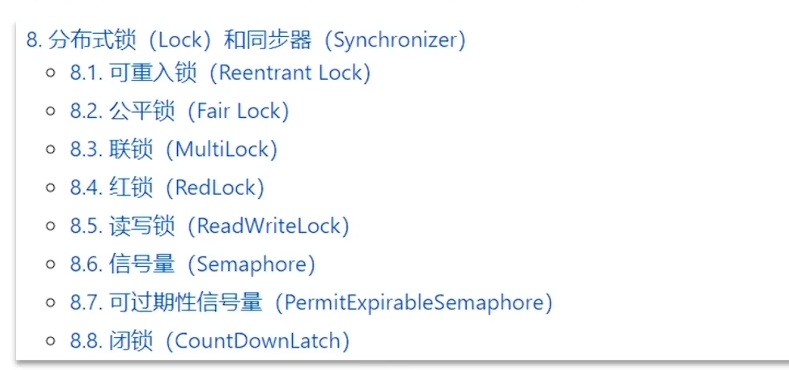
快速入门
配置
引入依赖:
<dependency>
    <groupId>org.redisson</groupId>
    <artifactId>redisson</artifactId>
    <version>3.13.6</version>
</dependency>
注册Redisson客户端配置项:
@Configuration
public class RedissonConfig {
    @Bean
    public RedissonClient redissonClient(){
        // 配置
        Config config = new Config();
        config.useSingleServer().setAddress("redis://192.168.150.101:6379")
            .setPassword("123321");
        // 创建RedissonClient对象
        return Redisson.create(config);
    }
}
简单示例
@Resource
private RedissionClient redissonClient;

@Test
void testRedisson() throws Exception{
    //获取锁(可重入),指定锁的名称
    RLock lock = redissonClient.getLock("anyLock");
    //尝试获取锁,参数分别是:获取锁的最大等待时间(期间会重试),锁自动释放时间,时间单位
    boolean isLock = lock.tryLock(1,10,TimeUnit.SECONDS);
    //判断获取锁成功
    if(isLock){
        try{
            System.out.println("执行业务");
        }finally{
            //释放锁
            lock.unlock();
        }

    }
}
使用
在 VoucherOrderServiceImpl注入 RedissonClient 来替代我们自己建立的锁
通过 getLock 获取锁对象 -> 然后用锁对象来trylock尝试获取锁 -> 最后判断
@Resource
private RedissonClient redissonClient;

@Override
public Result seckillVoucher(Long voucherId) {
        // 1.查询优惠券
        SeckillVoucher voucher = seckillVoucherService.getById(voucherId);
        // 2.判断秒杀是否开始
        if (voucher.getBeginTime().isAfter(LocalDateTime.now())) {
            // 尚未开始
            return Result.fail("秒杀尚未开始!");
        }
        // 3.判断秒杀是否已经结束
        if (voucher.getEndTime().isBefore(LocalDateTime.now())) {
            // 尚未开始
            return Result.fail("秒杀已经结束!");
        }
        // 4.判断库存是否充足
        if (voucher.getStock() < 1) {
            // 库存不足
            return Result.fail("库存不足!");
        }
        Long userId = UserHolder.getUser().getId();
        // 创建锁对象 这个代码不用了,因为我们现在要使用分布式锁
        // SimpleRedisLock lock = new SimpleRedisLock("order:" + userId, stringRedisTemplate);
        RLock lock = redissonClient.getLock("lock:order:" + userId);
        // 获取锁对象
        boolean isLock = lock.tryLock();

        // 加锁失败
        if (!isLock) {
            return Result.fail("不允许重复下单");
        }
        try {
            // 获取代理对象(事务)
            IVoucherOrderService proxy = (IVoucherOrderService) AopContext.currentProxy();
            return proxy.createVoucherOrder(voucherId);
        } finally {
            //释放锁
            lock.unlock();
        }
 }
原理分析
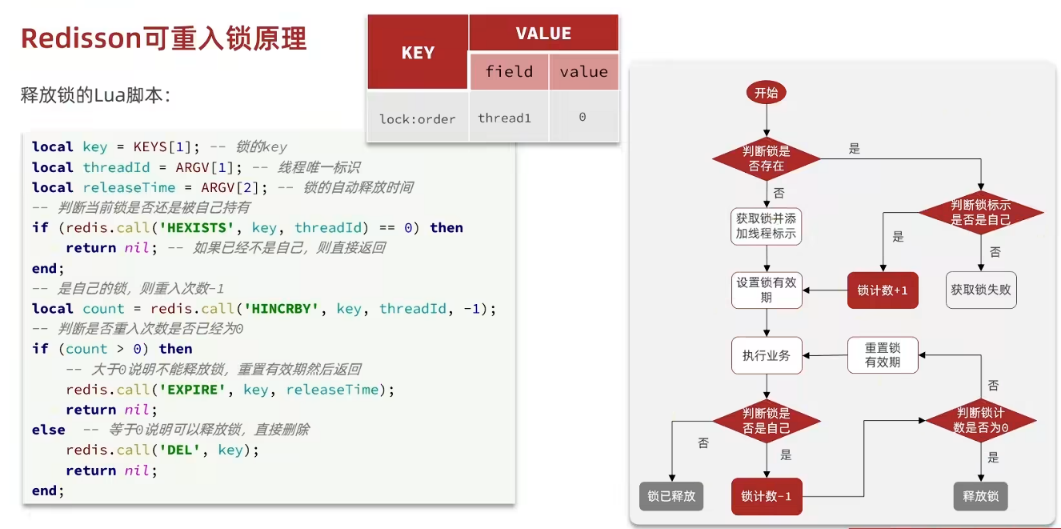
redission可重入锁原理
在Lock锁中,他是借助于底层的一个voaltile的一个state变量来记录重入的状态的,比如当前没有人持有这把锁,那么state=0,假如有人持有这把锁,那么state=1,如果持有这把锁的人再次持有这把锁,那么state就会+1
如果是对于synchronized而言,他在c语言代码中会有一个count,原理和state类似,也是重入一次就加一,释放一次就-1 ,直到减少成0时,表示当前这把锁没有被人持有。
在redission中,支持可重入锁
在分布式锁中,采用hash结构用来存储锁,其中大key表示表示这把锁是否存在,用小key表示当前这把锁被哪个线程持有,对应的 value 则是该锁被同一个线程获取的次数,类似的,当有人来再次持有这把锁,对应的 value + 1,释放一次就 -1、
测试代码
@SpringBootTest
@Slf4j
public class RedissonTest {

    @Resource
    private RedissonClient redissonClient;
    private RLock lock;

    @BeforeEach
    void setup(){
        lock = redissonClient.getLock("lock");
    }

    @Test
    void method1(){
        boolean isLock = lock.tryLock();
        if(!isLock){
            log.error("获取失败 1");
            return;
        }
        try{
            log.info("获取锁成功 1");
            method2();
            log.info("任务执行 1");
        }finally {
            log.warn("释放锁 1");
            lock.unlock();
        }
    }

    @Test
    void method2(){
        boolean isLock = lock.tryLock();
        if(!isLock){
            log.error("获取失败 2");
            return;
        }
        try{
            log.info("获取锁成功 2");
            log.info("任务执行 2");
        }finally {
            log.warn("释放锁 2");
            lock.unlock();
        }
    }
}
当执行第一个 test 时获取锁:

当进入 method2 时再次获取锁:

随后先 method2 释放锁 -1 然后 method1 释放锁 -1 最终真正释放
Redission源码分析
获取锁 lock.trylock()
对于 Lock 的实现类 RedissonLock
public boolean tryLock() {
    return (Boolean)this.get(this.tryLockAsync());
}

// 对应的tryLockAsync
public RFuture<Boolean> tryLockAsync() {
    return this.tryLockAsync(Thread.currentThread().getId());
}

public RFuture<Boolean> tryLockAsync(long threadId) {
    return this.tryAcquireOnceAsync(-1L, -1L, (TimeUnit)null, threadId);
}

private RFuture<Boolean> tryAcquireOnceAsync(long waitTime, long leaseTime, TimeUnit unit, long threadId) {
    // 先判断 leaseTime 是否为 -1 (所自动释放的时间)
    if (leaseTime != -1L) {
        return this.<Boolean>tryLockInnerAsync(waitTime, leaseTime, unit, threadId, RedisCommands.EVAL_NULL_BOOLEAN);
    } else {
        // 没有释放时间,设置默认值
        RFuture<Boolean> ttlRemainingFuture = this.<Boolean>tryLockInnerAsync(waitTime, this.commandExecutor.getConnectionManager().getCfg().getLockWatchdogTimeout(), TimeUnit.MILLISECONDS, threadId, RedisCommands.EVAL_NULL_BOOLEAN);

        ttlRemainingFuture.onComplete((ttlRemaining, e) -> {
            if (e == null) {
                if (ttlRemaining) {
                    this.scheduleExpirationRenewal(threadId);
                }

            }
        });
        return ttlRemainingFuture;
    }
}
分析对应的 tryLockInnerAsync 方法
<T> RFuture<T> tryLockInnerAsync(long waitTime, long leaseTime, TimeUnit unit, long threadId, RedisStrictCommand<T> command) {
    this.internalLockLeaseTime = unit.toMillis(leaseTime);
    return this.<T>evalWriteAsync(this.getName(), LongCodec.INSTANCE, command,
    "if (redis.call('exists', KEYS[1]) == 0) "+
    "then redis.call('hincrby', KEYS[1], ARGV[2], 1); "+
    "redis.call('pexpire', KEYS[1], ARGV[1]); "+
    "return nil; "+
    "end; "+
    "if (redis.call('hexists', KEYS[1], ARGV[2]) == 1) "+
    "then redis.call('hincrby', KEYS[1], ARGV[2], 1); "+
    "redis.call('pexpire', KEYS[1], ARGV[1]); "+
    "return nil; "+
    "end; "+
    "return redis.call('pttl', KEYS[1]);"
    , Collections.singletonList(this.getName()), this.internalLockLeaseTime, this.getLockName(threadId));
}
通过 lua 脚本来进行判断
先判断锁是不是存在-> 不存在, 创建锁自增1 + 设置过期时间, 返回 nil | 存在 -> 判断是不是自己的 -> 是 +1 重置过期时间 | 不是 失败
释放锁 lock.unlock()
对应在 RedissonLock
public void unlock() {
    try {
        this.get(this.unlockAsync(Thread.currentThread().getId()));
    } catch (RedisException e) {
        if (e.getCause() instanceof IllegalMonitorStateException) {
            throw (IllegalMonitorStateException)e.getCause();
        } else {
            throw e;
        }
    }
}

public RFuture<Void> unlockAsync(long threadId) {
    RPromise<Void> result = new RedissonPromise();
    RFuture<Boolean> future = this.unlockInnerAsync(threadId);
    future.onComplete((opStatus, e) -> {
        this.cancelExpirationRenewal(threadId);
        if (e != null) {
            result.tryFailure(e);
        } else if (opStatus == null) {
            IllegalMonitorStateException cause = new IllegalMonitorStateException("attempt to unlock lock, not locked by current thread by node id: " + this.id + " thread-id: " + threadId);
            result.tryFailure(cause);
        } else {
            result.trySuccess((Object)null);
        }
    });
    return result;
}
分析对应的 unlickInnerAsync()
protected RFuture<Boolean> unlockInnerAsync(long threadId) {
    return this.<Boolean>evalWriteAsync(this.getName(), LongCodec.INSTANCE, RedisCommands.EVAL_BOOLEAN,
    "if (redis.call('hexists', KEYS[1], ARGV[3]) == 0) "+
    "then return nil; "+
    "end; "+
    "local counter = redis.call('hincrby', KEYS[1], ARGV[3], -1); "+
    "if (counter > 0) "+
    "then redis.call('pexpire', KEYS[1], ARGV[2]); "+
    "return 0; "+
    "else redis.call('del', KEYS[1]); "+
    "redis.call('publish', KEYS[2], ARGV[1]); "+
    "return 1; "+
    "end; "+
    "return nil;", Arrays.asList(this.getName(), this.getChannelName()), LockPubSub.UNLOCK_MESSAGE, this.internalLockLeaseTime, this.getLockName(threadId));
}
同样也是利用 lua 脚本来判断删除锁的逻辑
先判断锁是不是自己 -> 是自己, 锁次数就减1 -> 判断锁重复次数是否为0 -> 大于0, 重置有效期 | 为0 删除锁,并进行通知
redission锁重试和WatchDog机制
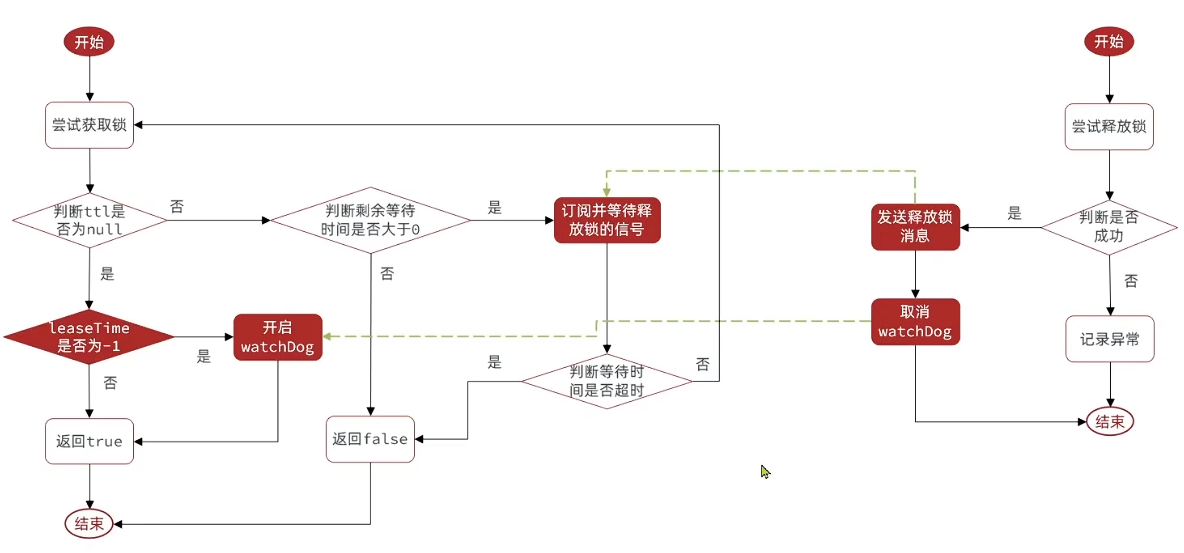
trylock含参数下的锁重试 (waitTime)
boolean isLock = lock.tryLock(1L, TimeUnit.SECONDS);
此时设置了等待时间,对应的源码如下:
// 给了 waitTime 所以存在等待时间 可能会锁重试
// leaseTime 为释放时间,-1为默认值 30s
public boolean tryLock(long waitTime, TimeUnit unit) throws InterruptedException {
    return this.tryLock(waitTime, -1L, unit);
}

public boolean tryLock(long waitTime, long leaseTime, TimeUnit unit) throws InterruptedException {
    long time = unit.toMillis(waitTime);
    long current = System.currentTimeMillis();
    long threadId = Thread.currentThread().getId();
    Long ttl = this.tryAcquire(waitTime, leaseTime, unit, threadId);
    ...
}
先分析 this.tryAcquire(waitTime, leaseTime, unit, threadId);
对应源码:
// 现在版本加了一个 tryAcquireAsync0
// 原来是直接 return get(tryAcquireAsync(waitTime, leaseTime, unit, threadId));
// get 来等待阻塞获取最终的结果
private Long tryAcquire(long waitTime, long leaseTime, TimeUnit unit, long threadId) {
    return (Long)this.get(this.tryAcquireAsync0(waitTime, leaseTime, unit, threadId));
}

private RFuture<Long> tryAcquireAsync0(long waitTime, long leaseTime, TimeUnit unit, long threadId) {
    return this.getServiceManager().execute(() -> this.tryAcquireAsync(waitTime, leaseTime, unit, threadId));
}

private <T> RFuture<Long> tryAcquireAsync(long waitTime, long leaseTime, TimeUnit unit, long threadId) {
    RFuture<Long> ttlRemainingFuture;
    if (leaseTime > 0L) {
        // 如果给了释放时间
        ttlRemainingFuture = this.<Long>tryLockInnerAsync(waitTime, leaseTime, unit, threadId, RedisCommands.EVAL_LONG);
    } else {
        // 设定默认释放时间
        // this.internalLockLeaseTime = this.getServiceManager().getCfg().getLockWatchdogTimeout();
        // 依然是对应的看门狗时间 30000ms
        ttlRemainingFuture = this.<Long>tryLockInnerAsync(waitTime, this.internalLockLeaseTime, TimeUnit.MILLISECONDS, threadId, RedisCommands.EVAL_LONG);
    }
    // tryLockInnerAsync
    // 就是之前分析可重入时 调用 lua 脚本的函数

    // 好像是返回一个包装
    // 之前版本的定义比较简单 返回的是 RFuture<Long> 一个异步 来等待锁释放
    CompletionStage<Long> s = this.handleNoSync(threadId, ttlRemainingFuture);
    ttlRemainingFuture = new CompletableFutureWrapper(s);
    CompletionStage<Long> f = ttlRemainingFuture.thenApply((ttlRemaining) -> {
        if (ttlRemaining == null) {
            if (leaseTime > 0L) {
                this.internalLockLeaseTime = unit.toMillis(leaseTime);
            } else {
                this.scheduleExpirationRenewal(threadId);
            }
        }

        return ttlRemaining;
    });
    return new CompletableFutureWrapper(f);
}

// 如果锁不存在 redis.call('exists', KEYS[1]) == 0
// 或者 锁存在且有属于自己 redis.call('hexists', KEYS[1], ARGV[2]) == 1)
// 就自增1 并且更新 有效期
// 成功就返回 nil 否则返回锁的剩余有效期
<T> RFuture<T> tryLockInnerAsync(long waitTime, long leaseTime, TimeUnit unit, long threadId, RedisStrictCommand<T> command) {
    return this.commandExecutor.syncedEval(this.getRawName(), LongCodec.INSTANCE, command,
    "if ((redis.call('exists', KEYS[1]) == 0) or (redis.call('hexists', KEYS[1], ARGV[2]) == 1)) then " +
    "redis.call('hincrby', KEYS[1], ARGV[2], 1); " +
    "redis.call('pexpire', KEYS[1], ARGV[1]); " +
    "return nil; " +
    "end; "+
    "return redis.call('pttl', KEYS[1]);",
     Collections.singletonList(this.getRawName()), new Object[]{unit.toMillis(leaseTime), this.getLockName(threadId)});
}
// debug
// this.getRawName() ->返回的是 "lock"
// this.getLockName(threadId) -> "48820612-407a-4588-b79c-0b068041bd01:3"
在获取锁时,成功返回 null,失败返回 锁的剩余有效期 最终返回 RFuture<Long> ttlRemainingFuture
通过 get 来等待阻塞得到锁的剩余有效期后,回到 tryLock
public boolean tryLock(long waitTime, long leaseTime, TimeUnit unit) throws InterruptedException {
    // 可以等待的时间
    long time = unit.toMillis(waitTime);
    long current = System.currentTimeMillis();
    long threadId = Thread.currentThread().getId();
    // 得到锁的有效期
    Long ttl = this.tryAcquire(waitTime, leaseTime, unit, threadId);
    if (ttl == null) {
        return true;
    } else {
        // 获取锁失败逻辑

        // 计算前面消耗的时间,然后得到剩余的等待时间
        time -= System.currentTimeMillis() - current;
        if (time <= 0L) {
            // 等待久了 获取锁失败 返回 false
            this.acquireFailed(waitTime, unit, threadId);
            return false;
        } else {

            // 继续尝试获取锁
            // 重新获取当前时间
            current = System.currentTimeMillis();

            // subscribe 订阅 来等待别人释放锁的信号
            // 因为在 释放锁中的 lua 脚本
            // redis.call('publish', KEYS[2], ARGV[1]);
            // 来通知
            CompletableFuture<RedissonLockEntry> subscribeFuture = this.subscribe(threadId);

            try {
                // 尝试等待
                subscribeFuture.get(time, TimeUnit.MILLISECONDS);
            } catch (TimeoutException var21) {
                // 等待时间超了 就false
                if (!subscribeFuture.completeExceptionally(new RedisTimeoutException("Unable to acquire subscription lock after " + time + "ms. Try to increase 'subscriptionsPerConnection' and/or 'subscriptionConnectionPoolSize' parameters."))) {
                    subscribeFuture.whenComplete((res, ex) -> {
                        if (ex == null) {
                            // 取消订阅
                            this.unsubscribe(res, threadId);
                        }

                    });
                }

                this.acquireFailed(waitTime, unit, threadId);
                return false;
            } catch (ExecutionException var22) {
                // 执行失败?
                this.acquireFailed(waitTime, unit, threadId);
                return false;
            }

            boolean e;
            try {
                // 成功得到通知 锁释放了
                // 计算剩余可以等待时间
                time -= System.currentTimeMillis() - current;
                if (time > 0L) {
                    // 如果还有剩余 可以再次尝试获取锁
                    do {
                        long currentTime = System.currentTimeMillis();
                        // 再次尝试获取
                        ttl = this.tryAcquire(waitTime, leaseTime, unit, threadId);

                        // 成功获取 返回true
                        if (ttl == null) {
                            boolean var32 = true;
                            return var32;
                        }

                        // 失败就在查看是否还有剩余时间
                        time -= System.currentTimeMillis() - currentTime;
                        if (time <= 0L) {
                            this.acquireFailed(waitTime, unit, threadId);
                            boolean var31 = false;
                            return var31;
                        }

                        currentTime = System.currentTimeMillis();
                        // 再试一次
                        // 采用的是信号量?来等待获取
                        if (ttl >= 0L && ttl < time) {
                            // ttl 小于我剩余的等待时间
                            // 表示我有足够的时间可以等到这个锁释放
                            // 所以就等 ttl 时间释放就立即尝试获取
                            ((RedissonLockEntry)this.commandExecutor.getNow(subscribeFuture)).getLatch().tryAcquire(ttl, TimeUnit.MILLISECONDS);
                        } else {
                            // 等time的时间 如果还没释放就没必要等了
                            ((RedissonLockEntry)this.commandExecutor.getNow(subscribeFuture)).getLatch().tryAcquire(time, TimeUnit.MILLISECONDS);
                        }

                        time -= System.currentTimeMillis() - currentTime;
                    } while(time > 0L);

                    // 等待时间没了 返回false
                    this.acquireFailed(waitTime, unit, threadId);
                    boolean var16 = false;
                    return var16;
                }

                // 没剩余 失败 false
                this.acquireFailed(waitTime, unit, threadId);
                e = false;
            } finally {
                // 取消订阅
                this.unsubscribe((RedissonLockEntry)this.commandExecutor.getNow(subscribeFuture), threadId);
            }

            return e;
        }
    }
}
锁超时 — watchDog机制
必须确保我的锁是因为业务执行完释放,而不是超时释放,而我的业务还在阻塞没结束
在尝试获取锁的时候,会定义 RFuture<Long> ttlRemainingFuture,通过对应的异步完成机制来保证
private <T> RFuture<Long> tryAcquireAsync(long waitTime, long leaseTime, TimeUnit unit, long threadId) {
    RFuture<Long> ttlRemainingFuture;
    if (leaseTime > 0L) {
        ttlRemainingFuture = this.<Long>tryLockInnerAsync(waitTime, leaseTime, unit, threadId, RedisCommands.EVAL_LONG);
    } else {
        ttlRemainingFuture = this.<Long>tryLockInnerAsync(waitTime, this.internalLockLeaseTime, TimeUnit.MILLISECONDS, threadId, RedisCommands.EVAL_LONG);
    }

    CompletionStage<Long> s = this.handleNoSync(threadId, ttlRemainingFuture);
    ttlRemainingFuture = new CompletableFutureWrapper(s);
    CompletionStage<Long> f = ttlRemainingFuture.thenApply((ttlRemaining) -> {
        // 回调成功执行
        // 剩余有效期为null (表示获取到锁了)
        if (ttlRemaining == null) {
            if (leaseTime > 0L) {
                this.internalLockLeaseTime = unit.toMillis(leaseTime);
            } else {
                // 重新定义锁的有效期
                this.scheduleExpirationRenewal(threadId);
            }
        }

        return ttlRemaining;
    });
    return new CompletableFutureWrapper(f);
}
具体实现:
public RedissonBaseLock(CommandAsyncExecutor commandExecutor, String name) {
    super(commandExecutor, name);
    this.entryName = this.id + ":" + name;
}

protected String getEntryName() {
    return this.entryName;
}

protected void scheduleExpirationRenewal(long threadId) {
    // new一个新的entry
    // 里面封装了:当前线程id + 对应的定时刷新任务
    ExpirationEntry entry = new ExpirationEntry();
    // EXPIRATION_RENEWAL_MAP 是个ConcurrentMap 就是保证线程安全的map
    // this.getEntryName() 说可以理解为是锁的名称
    // 就是之前可以看到类似 48820612-407a-4588-b79c-0b068041bd01:3 这种

    // 不同的锁都会放在这个map里
    // 如果锁不存在 才放进去 返回为 null
    // 如果已经存在了 就不放 返回旧的 entry
    // 保证不管这个锁更新了几次 都是一个entry
    ExpirationEntry oldEntry = (ExpirationEntry)EXPIRATION_RENEWAL_MAP.putIfAbsent(this.getEntryName(), entry);

    if (oldEntry != null) {
        // 吧这个线程id放到 entry里
        // 因为定时任务有了 就不用存了
        oldEntry.addThreadId(threadId);
    } else {
        // 如果是第一次来 就会更新有效期
        entry.addThreadId(threadId);

        try {
            this.renewExpiration();
        } finally {
            if (Thread.currentThread().isInterrupted()) {
                this.cancelExpirationRenewal(threadId);
            }
        }
    }
}

// 创建一个延时任务 这个任务会在(默认10s)后执行
// 先刷新锁的有效期 然后又重新调用这个方法 来创建延时任务
private void renewExpiration() {
    ExpirationEntry ee = (ExpirationEntry)EXPIRATION_RENEWAL_MAP.get(this.getEntryName());
    if (ee != null) {
        // 定时 延时任务
        // 延时 this.internalLockLeaseTime / 3L (默认10s) 再执行
        Timeout task = this.getServiceManager().newTimeout(new TimerTask() {
            public void run(Timeout timeout) throws Exception {
                // 取出对应 entry
                ExpirationEntry ent = (ExpirationEntry)RedissonBaseLock.EXPIRATION_RENEWAL_MAP.get(RedissonBaseLock.this.getEntryName());
                if (ent != null) {
                    // 获取对应线程id
                    Long threadId = ent.getFirstThreadId();
                    if (threadId != null) {
                        // 刷新有效期
                        CompletionStage<Boolean> future = RedissonBaseLock.this.renewExpirationAsync(threadId);
                        future.whenComplete((res, e) -> {
                            if (e != null) {
                                RedissonBaseLock.log.error("Can't update lock {} expiration", RedissonBaseLock.this.getRawName(), e);
                                RedissonBaseLock.EXPIRATION_RENEWAL_MAP.remove(RedissonBaseLock.this.getEntryName());
                            } else {
                                if (res) {
                                    // 递归 重新调用自己来刷新锁
                                    RedissonBaseLock.this.renewExpiration();
                                } else {
                                    RedissonBaseLock.this.cancelExpirationRenewal((Long)null);
                                }

                            }
                        });
                    }
                }
            }
        }, this.internalLockLeaseTime / 3L, TimeUnit.MILLISECONDS);

        // entry来存定时任务
        ee.setTimeout(task);
    }
}

// 刷新当前线程持有锁有效期
protected CompletionStage<Boolean> renewExpirationAsync(long threadId) {
    return this.<Boolean>evalWriteAsync(this.getRawName(), LongCodec.INSTANCE, RedisCommands.EVAL_BOOLEAN,
    "if (redis.call('hexists', KEYS[1], ARGV[2]) == 1) "+
    "then redis.call('pexpire', KEYS[1], ARGV[1]); "+
    "return 1; "+
    "end; return 0;",
    Collections.singletonList(this.getRawName()),
    this.internalLockLeaseTime, this.getLockName(threadId));
}
只有等释放锁的时候,才会停止任务,不刷新有效期
public void unlock() {
    try {
        this.get(this.unlockAsync(Thread.currentThread().getId()));
    } catch (RedisException e) {
        if (e.getCause() instanceof IllegalMonitorStateException) {
            throw (IllegalMonitorStateException)e.getCause();
        } else {
            throw e;
        }
    }
}

public RFuture<Void> unlockAsync(long threadId) {
    return this.getServiceManager().execute(() -> this.unlockAsync0(threadId));
}

private RFuture<Void> unlockAsync0(long threadId) {
    CompletionStage<Boolean> future = this.unlockInnerAsync(threadId);
    CompletionStage<Void> f = future.handle((opStatus, e) -> {
        // 成功时 就会取消更新任务
        this.cancelExpirationRenewal(threadId);
        if (e != null) {
            if (e instanceof CompletionException) {
                throw (CompletionException)e;
            } else {
                throw new CompletionException(e);
            }
        } else if (opStatus == null) {
            IllegalMonitorStateException cause = new IllegalMonitorStateException("attempt to unlock lock, not locked by current thread by node id: " + this.id + " thread-id: " + threadId);
            throw new CompletionException(cause);
        } else {
            return null;
        }
    });
    return new CompletableFutureWrapper(f);
}

// 取消定时任务
protected void cancelExpirationRenewal(Long threadId) {
    // 获取对应定时任务
    ExpirationEntry task = (ExpirationEntry)EXPIRATION_RENEWAL_MAP.get(this.getEntryName());
    if (task != null) {
        if (threadId != null) {
            // 把id清空
            task.removeThreadId(threadId);
        }

        if (threadId == null || task.hasNoThreads()) {
            // 去除对应任务 cancel
            Timeout timeout = task.getTimeout();
            if (timeout != null) {
                timeout.cancel();
            }

            // 再把 entry 也去掉
            EXPIRATION_RENEWAL_MAP.remove(this.getEntryName());
        }

    }
}
总结
waitTime 是获取锁失败后可等待时间,触发会进行锁重试
leaseTime 是锁的有效时间,默认为-1,会触发看门狗机制,不断刷新锁的有效期,确保只有在业务结束才释放锁,否则根据对应的时间释放
Redisson分布式锁原理:
- 可重入:利用 hash 结构记录线程id和重入次数,在redis中
- 可重试:利用信号量和PubSub功能实现等待、唤醒,获取锁失败的重试机制
- 超时续约:默认没设 leaseTime时,利用 watchDog,每个一段时间(releaseTime/2)重置超时时间
redission锁的MutiLock原理
为了提高redis的可用性,我们会搭建集群或者主从,现在以主从为例
此时我们去写命令,写在主机上, 主机会将数据同步给从机,但是假设在主机还没有来得及把数据写入到从机去的时候,此时主机宕机,哨兵会发现主机宕机,并且选举一个slave变成master,而此时新的master中实际上并没有锁信息,此时锁信息就已经丢掉了
为了解决这个问题,redission提出来了MutiLock锁,使用这把锁咱们就不使用主从了,每个节点的地位都是一样的, 这把锁加锁的逻辑需要写入到每一个主丛节点上,只有所有的服务器都写入成功,此时才是加锁成功,假设现在某个节点挂了,那么他去获得锁的时候,只要有一个节点拿不到,都不能算是加锁成功,就保证了加锁的可靠性
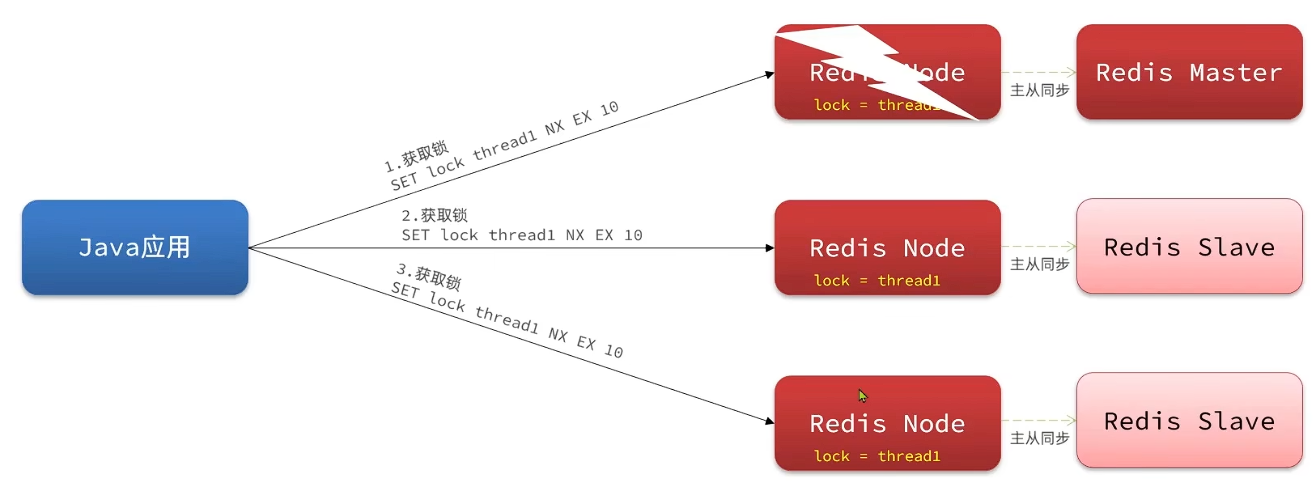
MutiLock原理
void setUp(){
    Rlock lock1 = redissonClient.getLock("order");
    Rlock lock2 = redissonClient.getLock("order");
    Rlock lock3 = redissonClient.getLock("order");

    lock = redissonClient.getMultiLock(lock1, lock2, lock3)
}
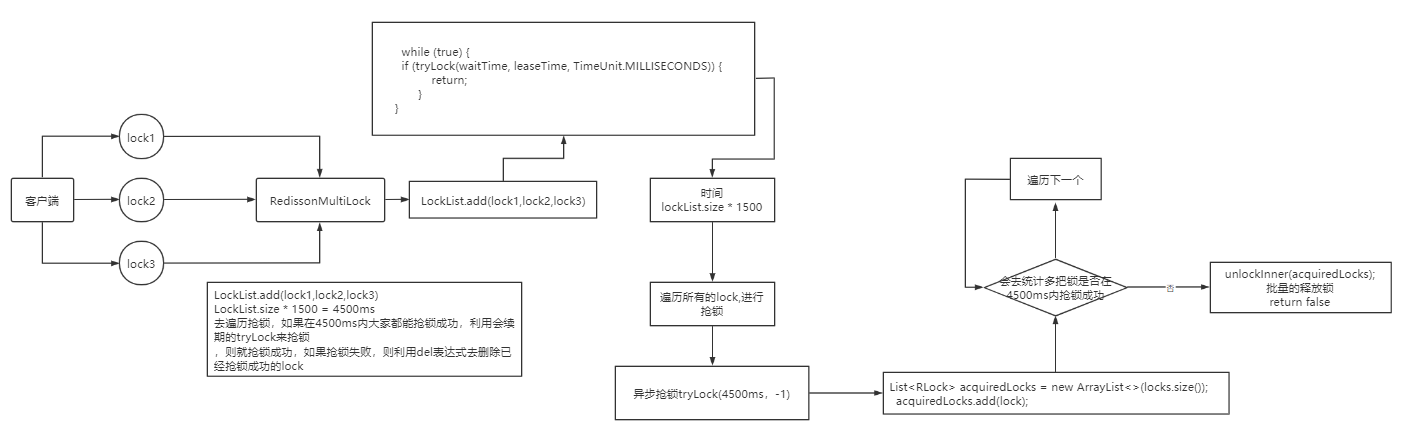
当我们去设置了多个锁时,redission会将多个锁添加到一个集合中,然后用while循环去不停去尝试拿锁,但是会有一个总共的加锁时间,这个时间是用需要加锁的个数 * 1500ms
假设有3个锁,那么时间就是4500ms,假设在这4500ms内,所有的锁都加锁成功,那么此时才算是加锁成功,如果在4500ms有线程加锁失败,则会再次去进行重试
总结
不可重入Redis分布式锁 (最简单, 自己实现的)
- 原理:利用
setnx命令的互斥性;利用ex避免死锁;释放锁时判断线程标示,避免误删 - 缺陷:不可重入、无法重试、锁超时就直接失效
- 原理:利用
可重入的Redis分布式锁 (Redisson中Lock)
- 原理:利用hash结构,记录线程标示和重入次数 (可重入);利用watchDog延续锁时间;利用信号量控制锁重试
- 缺陷:多redis,主节点失效无法同步时不行
Redisson的 multiLock:
- 原理:多个redis独立节点,必须在所有节点都获取重入锁,才算获取成功
- 缺陷:运维成本高,实现复杂